Leadership focus: connect cultural representation, material planning and assessment so that a curriculum’s commitments shape everyday teaching decisions.
Context: Grades 6–8 visual arts, Year 1 planning. My contribution: curriculum architecture, assessment design and classroom teaching resources. Evidence: the year map, grade rubrics and current project guides. This is a case study of documented design and revision; it does not claim measured school-wide gains.
In this case study: Problem · System · Evidence · Reflection · Next test
The problem: representation has to reach the structure
Representation has to reach the decisions a curriculum makes every week: whose work learners study, what materials they can use, how they return after absence and what a grade actually measures. A calendar of isolated celebrations cannot carry all of that work.
My Year 1 visual arts plan organizes fifteen units across Grades 6-8 and five shared media windows: Draw, Dry Build, Print, Color and Collage, and Construct. Shared windows coordinate materials across classes while each grade develops its own questions and expectations.
The planning problem has three connected parts. A cultural reference must do intellectual work in a lesson. Materials have to be available when students need them. Assessment must identify the artistic learning without allowing behavior or language proficiency to become an unofficial substitute. If these decisions are made separately, a strong statement of values can coexist with uneven access.
The system: coordinate the year, preserve the learner’s decisions
The artist sequence gives learners repeated encounters with Black artists, community knowledge and different ways to build meaning. John Steptoe anchors the studio’s identity. Artists including Ringgold, Parks, Lawrence, Thomas, Bearden, Catlett, Douglas and Butler support investigations of storytelling, observation, pattern, place and public voice. Pich extends the conversation about material, nature and memory.
The useful leadership question is what each reference makes possible in the learning. A portrait reference should change how students think about representing themselves. A print reference should deepen decisions about audience and message. A materials discussion should become something learners can test with the supplies in the room.
One shared resource calendar, different levels of reasoning
- Draw: coordinate the tools and references needed for looking, marks and image-making.
- Dry Build: stage construction materials and test how pieces connect.
- Print: plan shared equipment, consumables and return routines.
- Color and Collage: make paper, color and arrangement available for deliberate choices.
- Construct: test structure, drying and storage alongside the artistic brief.
These are the five media windows named in the Year 1 calendar. They coordinate resources; they are not five identical assignments repeated across grades. The developmental direction moves from making and explaining toward comparing, designing, interpreting and curating. A shared material does not require a shared answer.
Keep the art grade about art
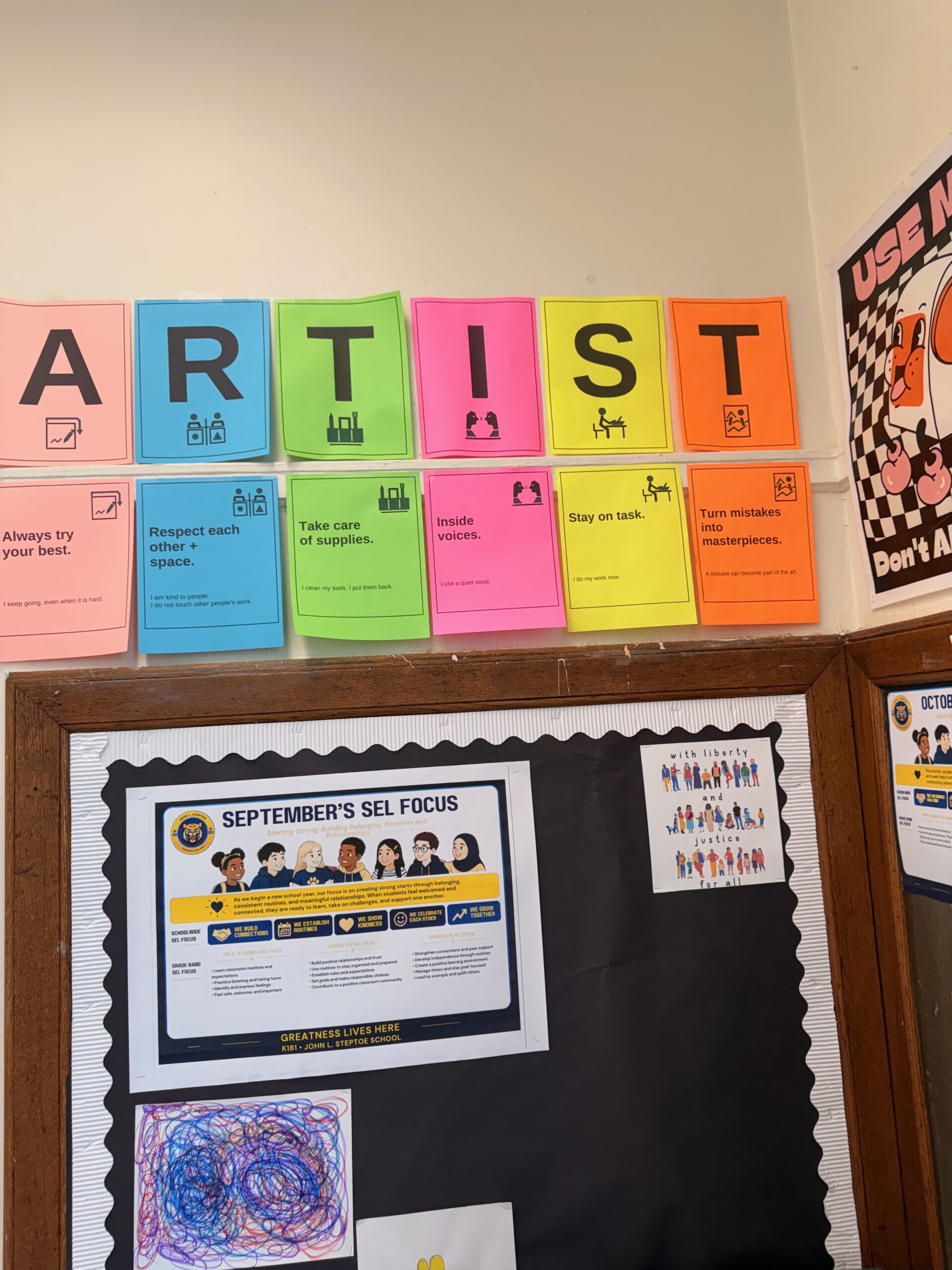
The traveling rubric separates artistic learning from Studio Habits. Creating, Presenting, Responding and Connecting hold the academic evidence. Routines, materials care and persistence are reported separately and never averaged into the art grade.
That separation makes the grading decision easier to examine. A learner who needs support with a transition can still show a deliberate composition. A multilingual learner can explain a choice by pointing, speaking or dictating. The teacher has to look at the artistic evidence rather than allowing compliance or English fluency to stand in for it.
The rubric’s developmental bands also name a next step. Before a conference, the learner self-scores and brings evidence. Studies and sketchbook investigations receive formative feedback; revision remains possible. This keeps assessment connected to a path forward.
The broader traveling-rubric architecture and the current project scoring sheet serve different purposes. In the current In Profile close, the October 21 three-row rubric is the sole scoring instrument. The older class-generated criteria remain inquiry evidence. They are not another layer of points. This distinction makes the intended assessment usable in a particular project without silently multiplying requirements.
The evidence: trace the design into a teachable lesson
Artifact 1 — the year map
The Year 1 calendar specifies fifteen units and five shared media windows. Its contribution is coordination: a colleague can see which materials need preparation and where work fits in a sequence. The map documents planned provision. A completed calendar cell alone would not establish what students learned.
Artifact 2 — the assessment boundary
A learner can need help with a transition and still make a deliberate artistic decision. The teacher records those two kinds of evidence separately.
The Grade 6 Traveling Rubric makes that separation explicit. Its developmental bands identify a next step rather than treating a low score as a fixed description of a student. In a conference, the learner points to evidence and the teacher responds to that evidence.
Artifact 3 — In Profile’s current closing sequence
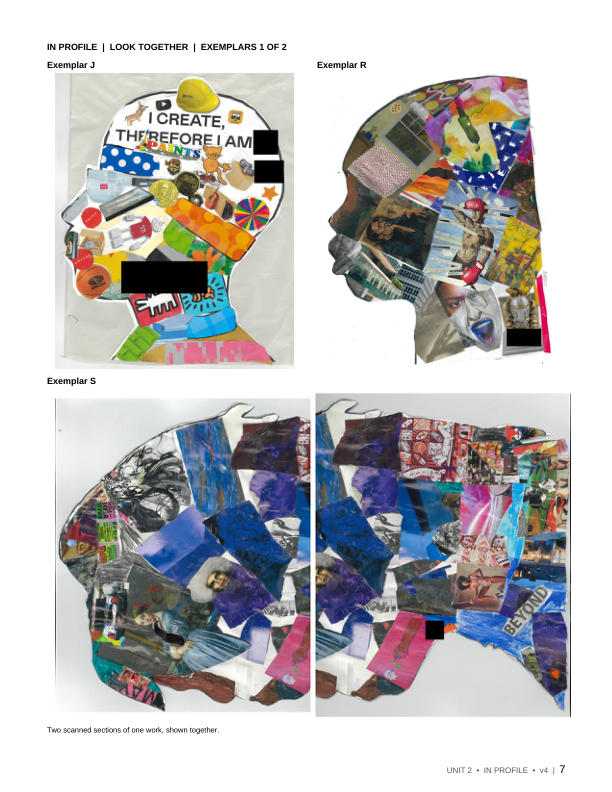
The published In Profile guide shows the principle in operation: students refine the artwork and draft an explanation together, repeat refinement contacts when needed, and move into a gallery close when ready. The teacher preserves ten minutes for viewing and seven for cleanup. There is no fixed sentence count or requirement to invent a flaw in successful work.
Artifact 4 — the same access principle across materials
In Space and Depth, the evidence is readable depth and its explanation, not neat handwriting or decoration. In Form, Nature and Meaning, supported cutting can coexist with a student-owned composition. The relief guide also requires actual joint tests and storage checks: a material constraint is part of planning, not something the learner should have to solve through home resources.
Reflection: coherence requires a usable version of the plan
The important design tension is consistency without rigidity. A common assessment language helps teachers communicate, but a project still needs a clear statement of what counts now. A common media window supports preparation, but students still need meaningful choices. A planned finish supports pacing, but readiness has to be judged from actual work.
The October revision to In Profile provides a concrete example of that balance. It retains the project’s artistic intention while replacing an automatic move to the final close with repeatable refinement. It also clarifies which rubric governs scoring. The leadership lesson in that revision is practical: a system becomes easier to use when its current decision rules are explicit.
The year map, unit evidence and material windows make the plan shareable. Another teacher can see what comes before a project, what students are expected to carry forward and what supplies need to be staged. The same map helps a leader ask whether ambitious goals are supported by the schedule and resources.
I read this design work through Danielson Domain 1: knowledge of content and pedagogy in 1a, and coherent instruction in 1e. That is an alignment interpretation, not an evaluation rating. The NYSED Visual Arts standards provide the academic progression.
The next test: can someone else use the system?
The artifacts establish an intentional curriculum and assessment structure. To evaluate implementation, I would use a small set of evidence rather than claim impact from the existence of the documents:
- Student explanation: Can a learner identify a visible choice and explain its effect, using an accessible response format?
- Assessment clarity: Can the learner and teacher point to evidence for the same current criterion?
- Colleague use: Can another teacher identify the materials, sequence, access supports and scoring boundary without relying on unwritten instructions?
A useful next review would pair work in progress, a student explanation and teacher feedback from more than one contact. That would show whether the intended decision-making is actually available to learners. Attendance or achievement gains would require separate evidence over time.
Explore the work: Open Studio curriculum · Room 401 systems case study · Teaching portfolio.