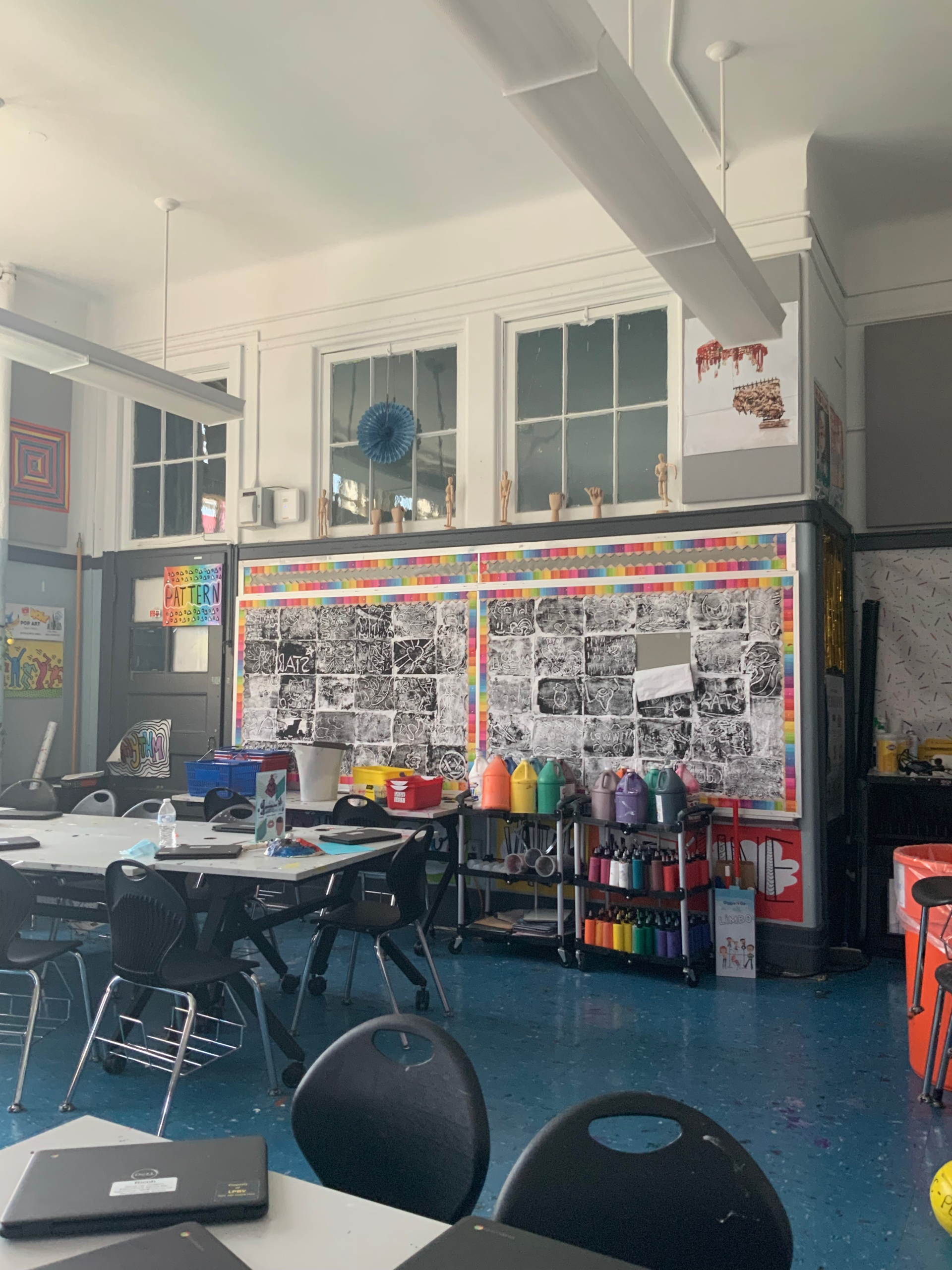
Leadership focus: make the next action visible so students can return to making and the teacher can spend more time on artistic thinking.
Context: middle school visual arts and Room 401 systems planning. My contribution: room organization, routines, role design and access pathways. Evidence: the studio playbooks and current lesson scripts. Archive photographs illustrate aspects of the studio environment; they are not a dated audit of every Room 401 zone.
In this case study: Problem · System · Evidence · Reflection · Next test
The problem: too many decisions depend on one adult
A studio transition is an instructional design problem. Materials need a home, unfinished work needs a return path and a learner who missed the demonstration needs a way to begin. When every answer lives with the teacher, the room creates a queue around one adult.
My Room 401 systems work makes those answers visible. The playbook begins with ten physical zones and adds an eleventh: the Catch-Up + Choice Bench. It connects the room’s layout with storage, vocabulary, display and re-entry after absence.
A missing tool, an unidentified wet artwork and a student returning after absence are different situations, but each can interrupt the room if the next action is unclear. The design challenge is to make the routine information accessible while keeping the teacher available for decisions that require instruction, care or professional judgment.
The system: connect places, jobs and taught routines
Give each kind of work an appropriate home
The playbook’s ten original zones, plus the added Catch-Up + Choice Bench, form a map of recurring tasks. The map is a functional plan; storage methods still have to be tested against the actual room and materials.
- 1. Threshold: entry cues, section sketchbooks and the current routine.
- 2. Table caddies: active tools with a numbered return location.
- 3. Staging counter: prepared consumables for table distribution.
- 4. Wet station: washable tools and cleanup supplies.
- 5. Drying: work separated by section and by handling needs.
- 6. Work in progress: named work, plans and loose pieces kept together.
- 7. Deep storage: inactive supplies kept out of daily circulation.
- 8. Vocabulary wall: illustrated terms that can be used during making and discussion.
- 9. Displays: studies, developing work, anchor pieces and connections across the year.
- 10. Transition point: a taught route for moving between spaces.
- 11. Catch-Up + Choice Bench: a focused re-entry task, continuing inquiry and visual technique resources.
Separate a destination from a reward
The added bench sits beside work-in-progress storage. Its catch-up rail identifies one useful task for a returning learner, rather than presenting an entire backlog. The choice tray and resource drawer give learners a route into further investigation. The playbook specifies a seat signal and a maximum of two students at a time. Access to the bench is neither a reward nor a consequence.
This is a re-entry design, not an attendance intervention claim. It addresses what happens when the learner returns. If a safety demonstration was missed, the relevant tool waits until the teacher reteaches it and checks the student’s use; a visible task card does not replace that instruction.
Use current roles with clear limits
The current studio roles are Studio Captain, Materials Assistant, Artwork Assistant and Timekeeper. The captain checks the posted reset. The materials assistant counts tools. The artwork assistant asks before moving another person’s work. The timekeeper protects transitions and the seven-minute cleanup.
Roles rotate and can be combined in a smaller group. They distribute meaningful work without giving students disciplinary authority. A job is a rehearsed contribution to the studio, not a title that makes one student responsible for controlling another.
Earlier playbooks describe a broader set of station-manager roles. The current In Profile guide names the four roles used here. Keeping the current role description beside the actual routine prevents older job titles from becoming an additional, competing layer of responsibility.
The evidence: routines become specific actions
Artifact 1 — a label that answers a question
The systems playbook specifies a word, icon and image or silhouette of contents, with a matching home label. “Caddy 4 → Table 4” turns a general request to put things away into a visible match. The principle is to reduce the language and memory demand of a routine while preserving the learner’s responsibility for the action.
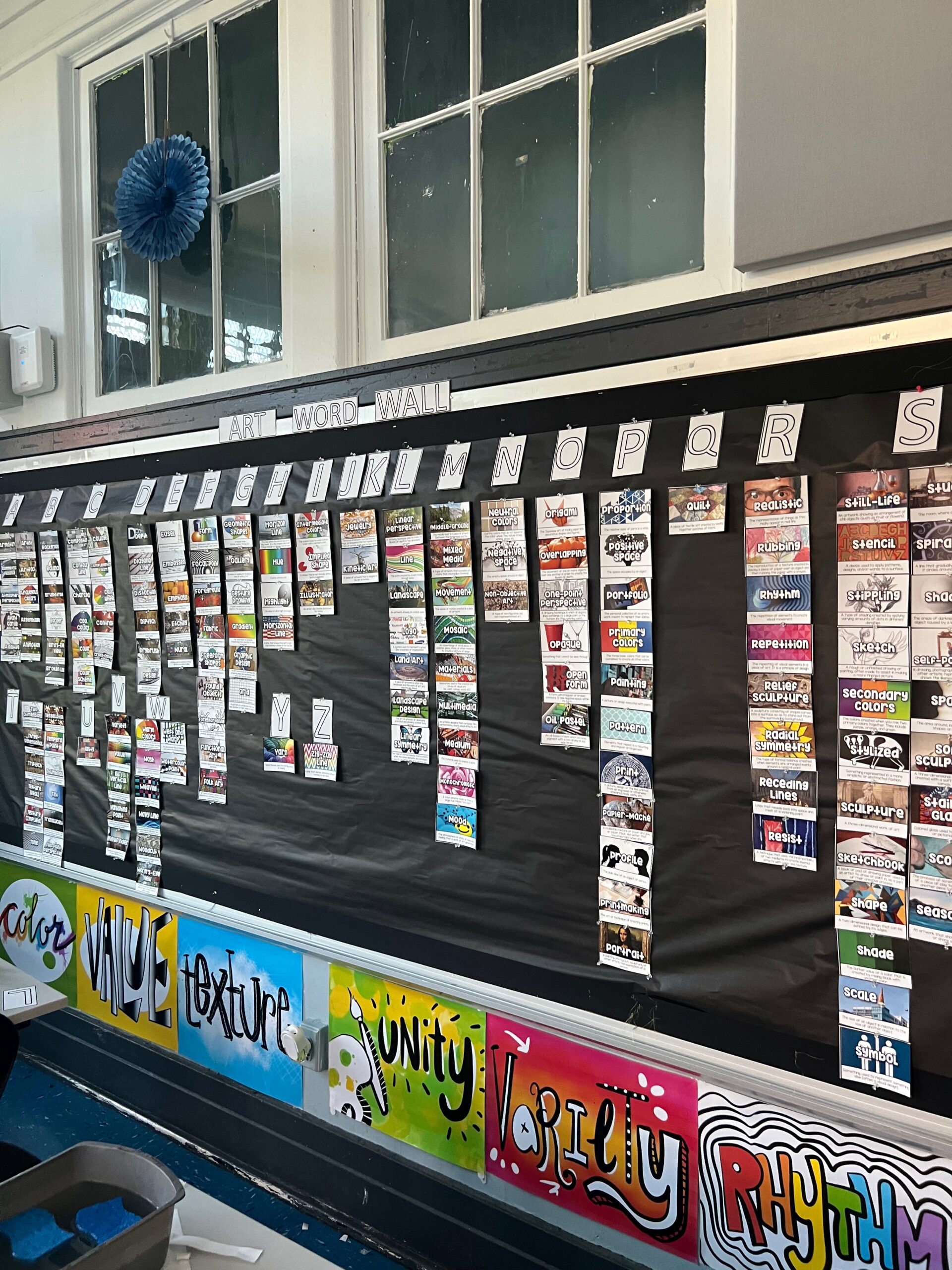
Artifact 2 — protect the last seven minutes
The relief teaching guide makes the reset observable:
- 38–39: confirm names and next steps.
- 39–42: carry bases on flat trays, keep wet joins separate, close glue and return scissors.
- 42–44: sort useful scraps, wipe tables and wash hands as needed.
- 44–45: check tools, floor and shelf clearance; the teacher dismisses.
This routine is a planned allocation, not a claim that every cleanup already takes exactly seven minutes. The teacher tests storage and material choices before teaching and adjusts optional paint when it requires an earlier stop. A student’s artistic judgment is assessed separately from cleanup performance.
Artifact 3 — a return path for unfinished work
In the profile transfer session, the learner saves a named base, an unglued cutout and the exact step to resume. An unfinished transfer receives continuation time. It does not automatically lower the art score or exclude the learner from shared paper inquiry and group composition.
Save the work, keep its parts together, and name the next action. Re-entry begins with a usable starting point.
Artifact 4 — clear directions, separate assessment
The behavior playbook asks the adult to check access and understanding before responding to apparent refusal. The redirect sequence begins with a nonverbal cue, then a positive group reminder, an anonymous correction and a private correction. Public correction is brief; consequences are proportionate and follow the school’s procedures and individual supports.
The aim is a clear next action delivered with dignity. “Return the tools to the caddy” is more usable than “be responsible.” Routines have to be taught and practiced before they can be expected.
The Class Studio Scorecard records collective routines separately from academic art criteria. A difficult cleanup does not erase evidence of a strong artistic decision. This boundary keeps behavior feedback from silently changing what the art grade means.
The behavior playbook’s additional boundaries matter: do not identify a student as the person who cost the class a point; do not remove art-making or display eligibility as a consequence; and do not confuse a classroom routine with authority to impose school-level disciplinary decisions. School procedures and individual supports govern any response. The scorecard is a record of collective routines, not an extra component of an individual art grade.
Reflection: independence has to be taught and checked
A posted system is only useful if a learner can use it. Labels can be visually clear and still be in the wrong place. A role can sound important and still be too broad to rehearse. A catch-up task can be concise and still miss the demonstration a learner needs. These are design questions to investigate, not reasons to assume refusal.
The current guides also refine older storage language: light, dry tracings may use tested hanging supports; wet or heavy mounted work stays flat and separate. The underlying principle is consistent, but the procedure changes with the actual material. Autonomy depends on that specificity.
The teacher remains responsible for safe tools, accessible directions, instruction and dismissal. Student jobs support the studio; they do not transfer adult disciplinary responsibility to children. The intended gain is more attention for teaching, not the disappearance of adult judgment.
The next test: does the routine give time back to learning?
The documents establish a planned system. They do not yet establish a measured reduction in interruptions, transition time or chronic absenteeism. A manageable implementation review would follow three questions:
- Starting: How long does it take a returning learner to locate work and begin a meaningful next action?
- Routine information: Which recurring questions still require the teacher, and what label, model or rehearsal might answer them?
- Learning after re-entry: Can the learner explain an artistic decision once work resumes? A fast transition alone is not the educational outcome.
Brief observation notes, examples of saved next-action records and student feedback would help identify what to revise. Review patterns across several contacts and different groups before drawing conclusions. The room is becoming more usable when students can navigate its routines and the teacher can attend more closely to their art.
Explore the work: The Word Wall as a Living Dictionary · Curriculum and assessment case study · Teaching portfolio.