The Block: Places We Call Home
Free to teach, adapt and share in your classroom.
- Grade 8 (adaptable 6–8)
- Subject Visual Arts
- Duration 10 sessions · 40 min
- Instructor Mr. George
Overview
Unit Context: Collage, place and community · Romare Bearden’s The Block · a ten-session studio unit that ends in a student-curated class street
Big Idea
A place is made of many stories. Collage argues that idea with its own body: a place is fragments, chosen and arranged. Students assemble a place that shaped them from torn, cut and painted paper, then join every collage into one shared street.
Students learn the whole method of collage before anything personal is asked of them. Session 1 is a postcard-sized study in choosing, arranging and committing fragments. Session 2 builds a shared library of hand-painted papers. Session 3 reads Bearden’s The Block for how it was assembled and turns a private memory map into content. The project then runs through a seven-step arc: launch, plan, make, make, refine, critique and show.
The central question is: How do artists assemble a place?
“Home” is defined broadly and said aloud to everyone: a block, a stoop, a kitchen, a grandmother’s couch, a country left behind, a place you wish existed. Fiction is legal. Bearden composed from memory and invention. No student is ever asked to show an address, a household or family details. The memory map stays private in the sketchbook, and students choose what reaches the wall. For students in unstable housing, this unit has to be a door, not a spotlight. Giving everyone the broad definition is the accommodation, so no one is marked by using it.
Planning status: This is a fully scripted Grade 8 plan written for the 2026–27 school year. The pacing below is the planned pacing. It is not a report of student outcomes.
Unit at a Glance
| # | Session and goal | Time |
|---|---|---|
| 1 | One-block fragment collageChoose, arrange and commit fragments into one small collage, and name the three moves. | 40 min |
| 2 | Painted-paper library (wet day, 50 minutes)Make textured collage papers worth sharing and contribute them to the class library. | 50 min |
| 3 | Bearden’s The Block + memory mapRead Bearden’s The Block for how it was assembled, and map a place that shaped me. | 40 min |
| 4 | Project launch (arc 1 of 7)Say what our project is, choose my route and name the place I’m assembling. | 40 min |
| 5 | Plan, the map becomes a composition (arc 2 of 7)Plan my collage’s composition and write my criteria, then leave room to improvise. | 40 min |
| 6 | Make 1, ground and architecture (arc 3 of 7)Lay my ground and place the big shapes of my place, unglued first and committed by the clock. | 40 min |
| 7 | Make 2, the stories layer (arc 4 of 7)Layer at least three stories into my place: people, objects, windows, lights. | 40 min |
| 8 | Refine + artist statement (arc 5 of 7)Tighten the composition and take my statement from draft to final: the place, the stories, and what a stranger would miss. | 40 min |
| 9 | Critique + finish, claim and evidence (arc 6 of 7)Audit a peer’s place-claim against its fragments and leave one usable suggestion. | 40 min |
| 10 | Show, The Class Block (arc 7 of 7, student-run)Assemble every place into one street, write its narrative and defend our self-scores. | 40 min |
| 10 sessions | 410 min |
Artist Anchor: Romare Bearden, The Block
Romare Bearden built The Block (1971), a six-panel collage of a Harlem street, from cut and pasted printed papers, colored and painted papers, photostats and paint on Masonite. It is in the collection of The Metropolitan Museum of Art. The street is invented as much as remembered. Every storefront and window is a place where a story can sit.
Bearden’s method is the unit’s actual medium, not an imitation of it. Route 1 uses his found-paper side and Route 2 uses his painted-paper side. When students say “collage,” they are naming his working process.
Look at the work together on The Met’s collection site and project it from there. Do not print or redistribute high-resolution copies.
NYS Visual Arts Standards Alignment
- VA:Cr1.1.8a Creating: documenting and reflecting on early stages of the creative process. Students turn the memory map into a plan spread in Session 5.
- VA:Cr2.1.8a Creating: experimenting and taking risks to pursue ideas, forms and meanings. Collage is a medium of risk, because every placement can be undone until it is glued (Sessions 1, 6 and 7).
- VA:Cr2.3.8a Creating: selecting, organizing and designing images and text to make clear, compelling work. Students place three stories into one place in Session 7.
- VA:Cr3.1.8a Creating: applying criteria to examine, reflect on and plan revisions. Students tighten the work against their own criteria in Sessions 8 and 9.
- VA:Pr5.1.8a Presenting: collaboratively preparing and presenting theme-based work and writing an exhibition narrative. The students run the Class Block show in Session 10.
- VA:Re8.1.8a Responding: analyzing how subject matter, form and media work together to convey meaning. Students write an artist statement that passes the pointing test.
- VA:Cn11.1.8a Connecting: reading a work for the time, place and community it came from. Students study Bearden’s Harlem in Session 3.
Instructional Outcomes (Objectives)
- Studio / Experiential Students will assemble a collage of a real or invented place from found and painted papers, with a readable place, at least three layered stories and a clear point of emphasis.
- Cognitive / Analytical Students will read The Block for how it was assembled, and back every claim in their statement and critique by pointing to a specific fragment.
- Community / Curatorial Students will make materials for one another through the shared paper library, then hang every collage as one street and write the narrative that street argues.
Key Vocabulary
The vocabulary arrives in stages, at the moment students need each term. On the Word Wall, each word is defined by a cut-paper sample the students made, not by written definitions alone.
- Choosing / selecting Deciding which fragments earn a place. Collage is mostly rejection. (Session 1)
- Arranging Moving fragments around before committing. “Gravity is your undo button.” (Session 1)
- Overlap One piece placed over another. It is the simplest way to show space, because you place depth instead of drawing it. (Session 1)
- Layering Building up paper in levels so a later layer can change an earlier decision. (Session 2)
- Texture The surface quality of a paper, made with combs, sponges, forks and cardboard edges. (Session 2)
- Montage / photomontage An image assembled from many separate images, some of them photographic. (Session 3)
- Assemblage A work built by combining found materials. (Session 3)
- Juxtaposition Two unlike things placed side by side so that the seam between them carries meaning. (Sessions 6–8)
- Negative shape The shape of the space around and between the pieces. (Sessions 6–8)
- Emphasis The one thing a viewer sees first. Everything else agrees to lose. (Sessions 5–8)
- Balance How visual weight is spread so the composition holds together. (Sessions 5–8)
- Scale How big one element is compared with another. (Sessions 6–7)
Materials & Resources
- Found printed matter: magazines, newsprint, flyers and maps, at least two boxes. Start a collection drive with families and staff before Session 1.
- Session 2 wet stations: tempera in a limited palette per table; texture tools (combs, sponges, forks, cardboard edges); brushes; 9 × 12 paper; aprons; floor paper; a cleared, row-labeled drying rack.
- Card-stock grounds: postcard size for Session 1 and 12 × 18 for the project.
- Glue sticks, counted out and counted back each session, and scissors, including adapted scissors. Tearing is a full alternative to scissors.
- Pull tray: pre-cut architectural shapes, a window bank, texture papers and L-brackets for checking composition.
- Bearden reference: The Block, projected from the museum’s collection page.
- Student handouts: memory-map sheets, See-Think-Wonder cards, thumbnail sheets, criteria cards, project briefs, statement-frame poster, claim-and-evidence critique cards and self-assessment slips.
- Teacher prototypes: one finished collage for each route, one fragment study and three painted papers, each made on the student clock.
- Display: a timeline strip of the seven arc cards, a studies wall, an in-progress wall with photocopied plans, and the Class Block wall with a marked grid.
Care routine, 15 seconds in every demo: say what the tool is, what it does and how we care for it. Glue is a dot, not a puddle, and lids are counted like scissors. The paper library is a shared commons. Torn edges are allowed; hoarding is not. Take what you will place today and return the rest sorted. A rotating library steward keeps the trays alive.
Two Routes, One Brief
- Route 1: Found-paper collage (default) Bearden’s found-paper side, made with free material. The whole class runs this route unless a conference moves a student. Drawing is optional.
- Route 2: Painted-paper collage (accessible alternative) Bearden’s painted-paper side, built from the Session 2 library that the whole class makes anyway. It is shown at the launch beside Route 1 and displayed at the same size with the same caption. It can earn the top rubric band.
The guarantee: every anchor is assembled from parts already made, so nobody starts from blank. The fragment study is the method at postcard scale, the paper library is the material, and the memory map is the content. The criteria are read aloud: the place is readable; at least three stories are layered in; the composition has emphasis and balance; the craft holds. Drawing ability, address accuracy and how pretty a home is are not on the list.
Differentiation
- Fine-motor and IEP supports Pre-cut shape and window banks, adapted scissors and a tearing route that is legal for everyone from the first thirty seconds. Students may work on a reduced field, such as one storefront instead of a whole block. A scribe or speech-to-text is available for the statement.
- Multilingual learners Each Word Wall term is defined by a cut-paper sample the student made and named. Students use sentence frames for the statement and critique (“This place is ___”, “Where I find it: ___”). Discussion openers are posted (“I noticed…”, “One thing I wonder about is…”). Students can rehearse with a partner before writing.
- Social-emotional / privacy Home is defined broadly for everyone, and fiction is legal. The map stays private. Statement frames say “as much or as little as you choose to say.” Sharing is voluntary, and passing is a normal answer. Critique is always about the collage, never the home.
- Advanced (conceptual, never more work) Build the same place at two times, then and now, in one frame and argue what the seam means. Or curate the Class Block’s narrative as its editor.
Anticipated Misconceptions
Misconception Precious-cutting paralysis: ten minutes spent hunting for the perfect image, with nothing placed.
Intervention Model rejection as the engine of the medium: pull five papers and keep two. If paralysis spreads, use the whole-class script: “Stop shopping. Take the three nearest papers and make them work. A collage is decisions, not the perfect scrap.”
Misconception “My home isn’t wall material.” Students whose housing is unstable, crowded or painful may quietly withdraw.
Intervention The broad definition is given to everyone, so no one is marked by using it. At the elbow: “Pick a place with ONE good texture in it: a countertop, a gate, a seat on the bus. A place that shaped you for twenty minutes counts.”
Misconception “Three stories? It’s a picture of a building.”
Intervention Use Bearden’s mechanism: every window is a story slot. A figure at one, a light in another, a curtain in a third. Stories can be objects too: the chair, the pot, the sneakers on the wire.
Misconception Literalism: “I can’t collage a smell, a memory, or my grandmother.”
Intervention “A red shape CAN be the smell of the kitchen. A patterned paper CAN be her dress without her face.” Pick the paper that feels like the story and place it where the story lived.
Instructional Sequence
Ten 40-minute sessions. Session 2 is a wet painting day and needs a 50-minute double or lunch-block slot. If that slot falls through, the paper library becomes a 15-minute station across Sessions 3–5. Every session follows the same five moves: entry problem, demo built on students’ own answers, studio block, student-run cleanup, and a closing share or check against the day’s goal.
Session 1One-block fragment collage
40 min
Today, I can… choose, arrange and commit fragments into one small collage, and name the three moves.
Why: the whole method at postcard scale, with nothing personal at stake. It runs first because it is dry. Arranging before gluing is enforced by a posted glue clock, not by an argument.
Materials today: Found-paper trays, postcard grounds, glue sticks (counted), scissors, Word Wall panel labeled choosing / arranging / overlap.
Do Now: two edges
One sheet of paper in every hand at the door. Add the new job, library steward, to the jobs chart while students watch.
“Tear one strip of paper. Cut another. Two different edges, and both are legal all month.”
“One of those edges has to be a wall and one has to be a sky. Which goes where, and why? Four words.”
Check: Two edges on every desk; a wall and a sky assigned with a reason. The room disagreeing is the point.
Props moment: five papers, keep two
Teach from two or three Do Now answers first. Then pull five papers, keep two and hold the three rejected pieces up before dropping them. Move pieces around unglued. Cross one over another. On the third pass, students instruct and you obey, including the wrong move.
“Collage is mostly rejection.”
“Gravity is your undo button.”
“I did not draw depth. I placed it. One piece in front of another is the cheapest space in art.”
Check: Cold-call three students: “What’s the last thing that happens, glue or arrange?”
Studio: one corner of any block
Post the glue clock. Arranging first; glue comes out only in the last 8 minutes. Real or invented corners count the same.
“Five fragments minimum. At least one torn, not cut. At least one overlap. That is a floor, not a target.”
“Point at your overlap. Which piece is in front?”
Students: Pull papers, arrange on the postcard ground, commit when the clock frees the glue. A mid-block freeze asks pairs: “What did the torn edge do that the cut edge couldn’t?” Then 90 seconds into the process log.
Cleanup: the commons returns sorted
Count glue sticks back in; scraps go back into trays sorted, never into the bin. Studies go up on the studies wall row by row. Two cut papers join the Word Wall, and students say the word aloud as they pin it.
Gallery lap
One silent lap, hands behind backs. We talk about the paper, never the person.
“Find one overlap that isn’t yours. What would change if the top piece went underneath?”
Check: Return to the opening goal: “Did that happen? Point at it.”
Misconception Hunting for the perfect scrap until minute 20 with nothing on the ground.
Intervention Hand over three papers from the top of the tray, face down, and ask for one overlap before you walk away. If four pieces are placed but every edge is cut and nothing crosses, say “tear one, cross the other over it,” then step back.
Session 2Painted-paper library (wet day, 50 minutes)
50 min
Today, I can… make textured collage papers worth sharing and contribute them to the class library.
Why: students make the class’s materials and then lend them to each other. Nobody starts the project from blank. The papers are not pictures; they are material.
Materials today: Limited tempera palette per table, texture tools, 9 × 12 paper, aprons, floor paper, cleared and row-labeled drying rack. Schedule in a double or lunch-block period.
Do Now: first tool
Aprons on, stations found. Process log dated.
“Which texture tool will you try FIRST?”
“Yesterday you chose from paper other people made. Today you make the paper, and it isn’t yours. It goes in the trays and somebody else’s block gets built out of it.”
Demo: texture, not pictures
Demonstrate two tools on one sheet: pull a comb through wet paint, press a sponge, drag a cardboard edge. Show where finished papers go: to the steward, never straight to the rack.
“You will know it worked when your papers are in a named tray and you can point at the reason they belong there.”
Studio: three papers minimum
Paint stays at its table; nobody carries paint. One pair of hands, the steward’s, at the rack.
“Three papers minimum, and not one of them is a picture. Start with the tool you logged.”
Students: Make at least three textured papers, each using a different tool or color move.
Check: Circulate: “Which of your papers would someone else reach for, and why?”
Extended wet cleanup
Brushes to the sink by station, rinsed until the water runs clear. Aprons stay on until the table is wiped. The steward counts rack rows; any paper without a section label comes to the teacher.
At the rack
Everyone stands at the rack, hands at sides. Nothing comes off it today.
“Tomorrow these dry into the library. You just made the class’s materials.”
“Name one paper on that rack that isn’t yours and that you’d use.”
Misconception Wet-day chaos: paint migrating, papers with no owner section, rack overload.
Intervention The protocol is the lesson plan: limited palettes per table, steward-only rack access, rows labeled by section. If a table cannot hold the protocol, it switches to dry texture rubbing and contributes that way. The library accepts every kind of paper.
Absent last time? Contribute two texture rubbings or one painted paper at the start of Session 3; the library is shared, so you begin Session 3 with materials like everyone else.
Session 3Bearden’s The Block + memory map
40 min
Today, I can… read Bearden’s The Block for how it was assembled, and map a place that shaped me.
Why: students now have the method and the materials. The content isn’t in the magazines; it is in their heads. This session is the culture anchor of the unit and is never cut.
Materials today: The Block projected; See-Think-Wonder (STW) cards; memory-map sheets; sketchbooks.
Do Now: walk a block in your head
“Close your eyes. Walk one block you know, ANY block, any year. Log three things you passed: one sound, one smell, one texture.”
“A stranger has never been where you just walked. Star the one of your three that tells them the most.”
Looking: See, Think, Wonder
Bridge from the Do Now: nobody starred an address. Choosing which fragment carries a place is exactly what Bearden did. Lead a slow looking sequence on The Block: what do you see; what does it make you think; what do you wonder. Name montage, photomontage and assemblage as students find them.
“Find a window. What story sits in it?”
“What did Bearden have to cut away to make this feel like one street?”
Students: Complete an STW card about one section of the work.
Memory map (private)
This is a 16-minute private block. Say the broad definition aloud: a stoop, a kitchen, a grandmother’s couch, a country, a place you wish existed.
“First move is one rough shape, the biggest thing in the place.”
“Fiction is legal. Bearden invented freely. Nobody will be asked whose house this is.”
Students: Map regions, paths and sensory notes; mark where stories happen. The map stays in the sketchbook.
Cleanup: cards up, maps closed
STW cards are clipped beside the projected work or posted print. Sketchbooks stay closed.
“Which one goes up, your card or your map? The map is yours; the collage is what you choose to show.”
Voluntary share
Two volunteers read two sensory notes, a sound and a smell, never the place itself. Passing is a normal answer.
“One thing I wonder about is…”
Misconception “My home isn’t wall material.”
Intervention Offer the sensory route instead of the place route: “Which of your three Do Now words has a texture in it?” A place that shaped you for twenty minutes counts.
Absent last time? Do the Do Now walk silently at your seat, then start the map; the STW card can be completed from the projection during the first studio block of Session 4.
Session 4Project launch (arc 1 of 7)
40 min
Today, I can… say what our project is, choose my route and name the place I’m assembling.
Materials today: Project brief at every seat; both finished teacher prototypes displayed; timeline strip; The Block re-posted; paper library visible.
Do Now: what a stranger needs
Move the timeline marker to LAUNCH.
“Circle the one region of your map you’d let a stranger see.”
“What would a stranger have to SEE to know it’s a place and not a pattern? Write two things.”
The launch
Every item students listed is a fragment, not the whole place. Walk the brief: the ask, both routes shown finished side by side, the criteria read aloud, the seven-step road and the Class Block ending.
“Assemble the place that shaped you from fragments, the way Bearden built The Block.”
“Home means whatever you decide it means. FICTION IS LEGAL, and I’m saying it here, at the moment you choose.”
Choose and seed
Students circle a route on the brief before touching paper; the route locks at PLAN next session.
“The two things you wrote at the door are your first test of PLACE READABLE. Pull the paper that starts one of them.”
Students: Circle a route, pull seed papers from the library, and write a working title for the place.
Cleanup
Brief glued flat into the sketchbook so it can still be read; papers returned sorted and right way up.
Route poll
Two routes, no better one.
“Which of the four criteria is hardest on the route you did NOT pick, and why?”
Misconception “Three stories? It’s a picture of a building.”
Intervention Hand three scraps over at the prototype, one window each, and ask the student to say what each one tells you. If all three stories are people, point at objects: the chair, the pot, the sneakers on the wire.
Absent last time? Read the brief at the in-progress wall, circle a route with the teacher at the start of Session 5, and take seed papers then.
Session 5Plan, the map becomes a composition (arc 2 of 7)
40 min
Today, I can… plan my collage’s composition and write my criteria, then leave room to improvise.
Why: collage planning is mapmaking, not drafting. Plan the place: its regions, its emphasis and where the stories go. Improvise the papers.
Materials today: Thumbnail sheets; criteria cards (“It succeeds if ___” × 3); library trays; pull tray with L-brackets; a plan-spread exemplar.
Do Now: emphasis point
“My place is ___ and its emphasis point, the thing you see FIRST, is ___.”
“Invented places count. No address, no household. That is never part of this.”
Loose-plan demo
Model a plan made only of regions and Xs, never outlines. Star the emphasis point; mark three story slots.
“Your plan is a map of decisions, not a picture of the answer.”
Check: Ask three students to name their first-seen element; none should say “the whole place.”
Plan spread
Two fast thumbnails, then choose one.
“Five things on the sheet: regions blocked, emphasis starred, three story slots marked, route named, and three criteria in your own words. If one is missing, it’s always the criteria.”
Students: Complete the plan spread; route locks.
Cleanup
Plan sheets to the teacher for photocopying; the copy goes on the in-progress wall “so your plan is here even when you’re not.” L-brackets counted back.
Emphasis share
Two volunteers name their emphasis point only, not their place.
“That’s what emphasis means: ONE thing wins, and everything else agrees to lose.”
Misconception The blueprint trap: a plan so detailed that the collage becomes coloring it in, and every improvised paper feels like a mistake.
Intervention “If a paper surprises you at the table, the plan lost fair and square. Log the change and keep it.” For a careful outline drawing, draw three boxes over it, star one and call that the plan.
Absent last time? Your Session 3 map is the starting point. Do the five-item plan spread during the first 10 minutes of Session 6 using the exemplar on the wall.
Session 6Make 1, ground and architecture (arc 3 of 7)
40 min
Today, I can… lay my ground and place the big shapes of my place, unglued first and committed by the clock.
Why: big shapes first. A stranger reads the architecture before the details, so it goes down first.
Materials today: Route stations live; 12 × 18 grounds; library trays run by the steward; plans on the wall; glue counted.
Do Now: entry ticket
Plans come off the wall and onto the grounds.
“Write the first move from your plan. That’s your entry ticket.”
“Two collages: three big shapes and no detail, or thirty small details and no big shapes. From six feet, which reads as a PLACE?”
Micro-demo: big shapes first
Lay a ground and three large shapes on your prototype, loose.
“Gravity is free. Glue is forever. Arrange until the clock frees the glue.”
Studio: ground down + three big shapes
No gluing before minute 25.
“Stand here with me. What do you see first?”
Students: Lay the ground and place at least three big architectural shapes.
Check: Floor check (posted): ground down + three big shapes placed, on every route.
Cleanup
Work to the in-progress shelf, scraps sorted, glue counted back.
Self-check
One student reads the floor check aloud; each student marks their own work met or not met.
Misconception Gluing at minute 12: commitment before composition, then regret.
Intervention Answer with the collage response, not a scolding: “Collage forgives. The next layer can eat that decision.” If shapes are small and many, sweep them aside and hand over three large papers.
Absent last time? Your plan is photocopied on the in-progress wall. Start there, not at the teacher’s desk. No explanation needed.
Session 7Make 2, the stories layer (arc 4 of 7)
40 min
Today, I can… layer at least three stories into my place: people, objects, windows, lights.
Why: yesterday students built a building. Today it becomes a place. Bearden’s windows are story slots.
Materials today: Stations as Session 6; window bank featured in the pull tray; The Block re-posted at eye level.
Do Now: three stories
“Name your three stories, three words each. A story can be invented.”
“Which tells a stranger more, the whole kitchen or one thing left on the counter?”
Micro-demo: the specific thing
Students choose the one thing on the counter, because it is specific. That is the whole demo. Place one small object in a window on the prototype.
Studio: place three stories
“First move: place your smallest story.”
“Show me story one… two… three.”
Students: Place at least three stories using figures, objects, windows and lights; drawing optional.
Check: Floor check: three stories placed and findable.
Cleanup
Window and figure shapes counted back into their compartment; scraps sorted.
“Torn edges are legal. Hoarding is not.”
Exit ticket
Check: Exit ticket below.
Misconception Literalism: “I can’t collage a smell.”
Intervention Hand over the tray and ask only which paper feels like the story, then place it together. When The Block was first shown, it came with a recorded soundtrack of the street, and Bearden built that rhythm into the paper.
Absent last time? Write your three stories first, then place one before the end of the block. The window bank is the fastest start.
Exit Ticket Prompt
Which story will a stranger find FIRST? One line in your log. (Students may say yes or no to having it read aloud next time without their name.)
Session 8Refine + artist statement (arc 5 of 7)
40 min
Today, I can… tighten the composition and take my statement from draft to final: the place, the stories, and what a stranger would miss.
Why: the collage stops growing today and starts arguing for itself. Every sentence in the statement has to point at something a viewer can find.
Materials today: Statement frames poster (“This place is ___ (as much or as little as you choose to say) · Three stories in my collage ___ · What a stranger would miss ___ · My seam means ___ · This place made me ___”); draft cards; works and plans side by side.
Do Now: which sentence points?
“‘This place is important to me.’ and ‘The warm papers stop at the third floor.’ Which one could a stranger check from the doorway?”
The pointing test
Name the test: every sentence has to point at a fragment. Model a juxtaposition pass: two papers that don’t belong together, now touching.
“These two don’t belong together. Now they touch. What does the seam between them say?”
Refine (10 min) + statement (8 min)
At minute 22 every pen moves to the final card. Announce it now.
“You will know it worked when your first sentence points at a fragment somebody could find from where they stand.”
Students: One refine pass on the collage, then a final statement card using the frames.
Statements to works
Final side out, clipped to the work; nothing goes through the collage.
What a stranger would miss
Volunteers read only their “stranger would miss” line. Nothing gets said back.
Misconception A statement that over-shares or over-hides.
Intervention For the student who hides: “Don’t tell me where. Tell me what it taught your hands.” For the student who over-shares: “The wall gets the meaning; the sketchbook keeps the rest.”
Absent last time? Use your Session 7 exit ticket as sentence one; dictation is available.
Session 9Critique + finish, claim and evidence (arc 6 of 7)
40 min
Today, I can… audit a peer’s place-claim against its fragments and leave one usable suggestion.
Materials today: Claim-and-evidence cards (“Their place claims ___ · Where I find it ___ · Where it breaks ___ · Next you could ___”); pairs pre-assigned; statements clipped to works.
Do Now: the rule, in your hand
“Copy the four lines onto your card. On the back, in your own words: we critique the COLLAGE, never the home.”
“‘I like the colours.’ or ‘The doorway loses to the sky.’ Which one could the maker act on tomorrow?”
Fishbowl: claim and evidence
Model one audit with a volunteer’s work in front of the room: claim, where I find it, where it breaks, next you could.
Partner exchange
Students go to their partner’s work; the work does not move. Four writing minutes in the middle are protected.
“The part that first caught my eye…”
“One thing I wonder about is…”
Revision + finish
Card returned to its maker.
“Answer your card in the log. Then revise the piece or the statement; your call.”
“Your three criteria from Session 5: met, not met, or changed and why.”
Cards travel with the work
Card clipped to its work, statement underneath; clips only.
One suggestion that helped
“Name a suggestion you got today and what it changed.”
“One thing our critique did well today, and one thing we do better next time.”
Misconception Critique drifting from the composition to the student’s circumstances.
Intervention Point at the rule on the back of the card. Re-aim: “Say it about the fragment. Where does the COMPOSITION break?” One warning, then the pair rotates. This unit protects its makers first.
Absent last time? Pair with the teacher for the audit, then use the revision block as normal.
Session 10Show, The Class Block (arc 7 of 7, student-run)
40 min
Today, we can… assemble every place into one street, write its narrative and defend our self-scores.
Why: ten sessions of separate places become one street, and the street makes an argument none of the students has written down yet.
Materials today: Class Block wall cleared and grid marked; display role cards (block planners, hangers, caption editors, narrators, flow-checkers); exhibition-narrative frame (“This street holds ___ places · Together they argue ___”); self-assessment slips; conference table and timer; rubric.
Do Now: roles + self-score
Students claim a display role at the door.
“Two collages hang side by side. What does the street say by putting them together that neither says alone?”
Walk-through + caption brief
Planners get their brief: vary the eye line, let rooflines stagger, put seam pieces where they can argue across the street, and leave one labeled gap “for the places not pictured.”
Assemble, caption, narrate
The street goes up first; captions and narrative run beside it. Mini-conferences run in parallel: the student self-scores first, then the teacher.
“Every caption is a cut of your OWN statement. Nobody writes thirty words about somebody else’s home.”
Finish + conferences continue
Student-run close-down while conferences finish.
Wall walk
Silent walk end to end; narrators read the exhibition narrative to the street.
“Name one thing our talk did well this unit.”
Misconception The street flattens into a grid: 25 rectangles filed like paperwork.
Intervention One question to the crew: “Where does the eye rest? Nowhere? Fix that.” Raise three works off the line and let the crew read the difference from six feet.
Absent last time? An absent student’s collage is hung by the crew with a caption cut from their statement; their conference moves to the next available session.
Assessment & Reflection
- Formative (feedback, never grades) Fragment study, painted papers, memory map (private), plan spread, floor checks at Sessions 6 and 7, process log dated every session.
- Summative The place collage and artist statement, scored against a four-band rubric in a mini-conference where the student self-scores first, plus contribution to the Class Block narrative.
- Criteria (read aloud at launch) Place readable · at least three stories layered in · composition with emphasis and balance · craft. Not on the list: drawing ability, address accuracy, “prettiness of home.”
- Studio habits (kept separate from art criteria) Glue and library routines, returning the commons sorted, critique that lands on the work. These are coached, not scored as art.
Revision is always allowed, and the portfolio holds everything. An optional extension set of five 40-minute sessions supports sections that have extra meetings.
Related Lessons
In Profile: Silhouette and Collage builds earlier paper and collage skills. The Politics of Perception shares the same commitment to looking before judging.
Sources & Credits
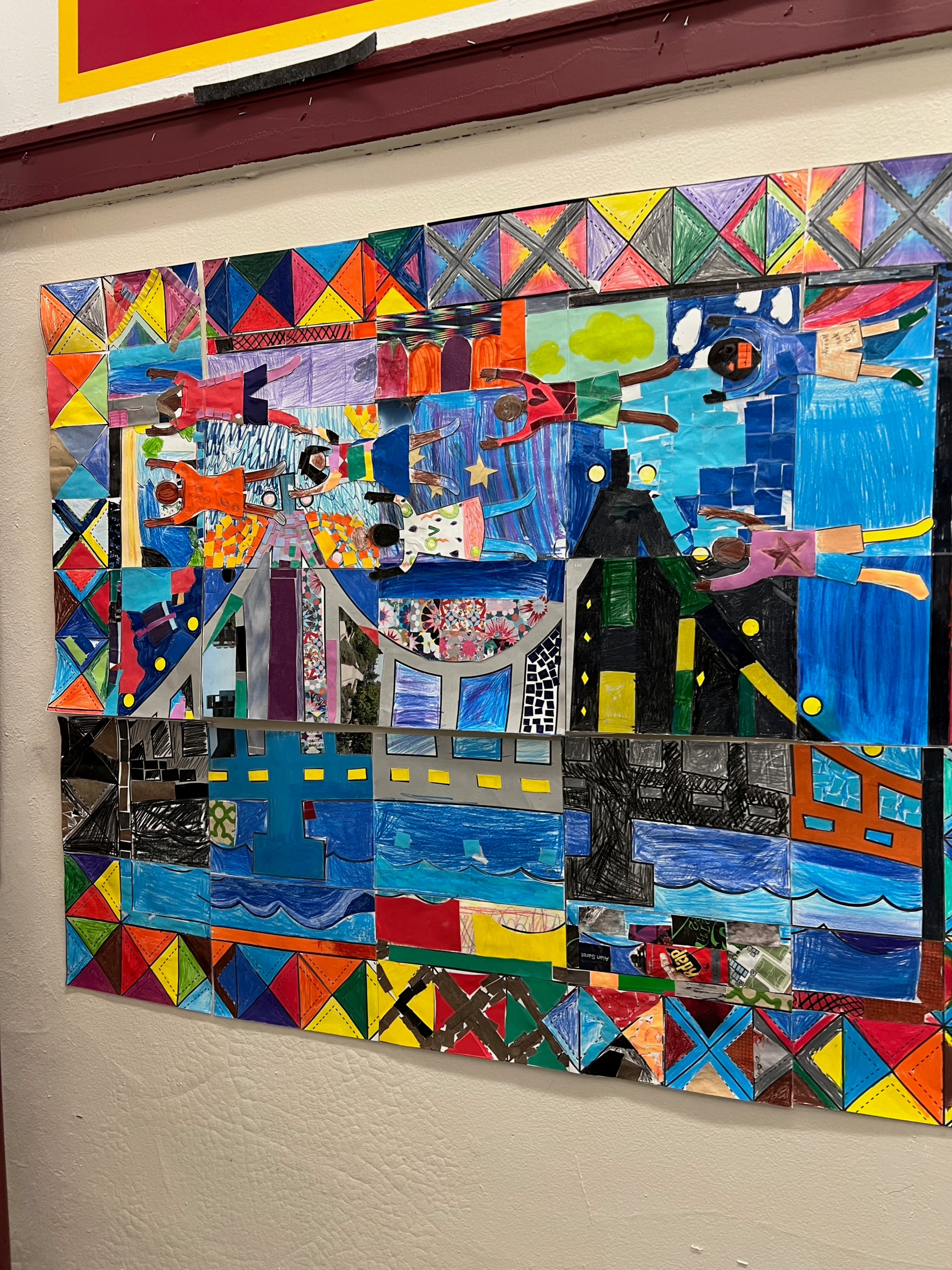
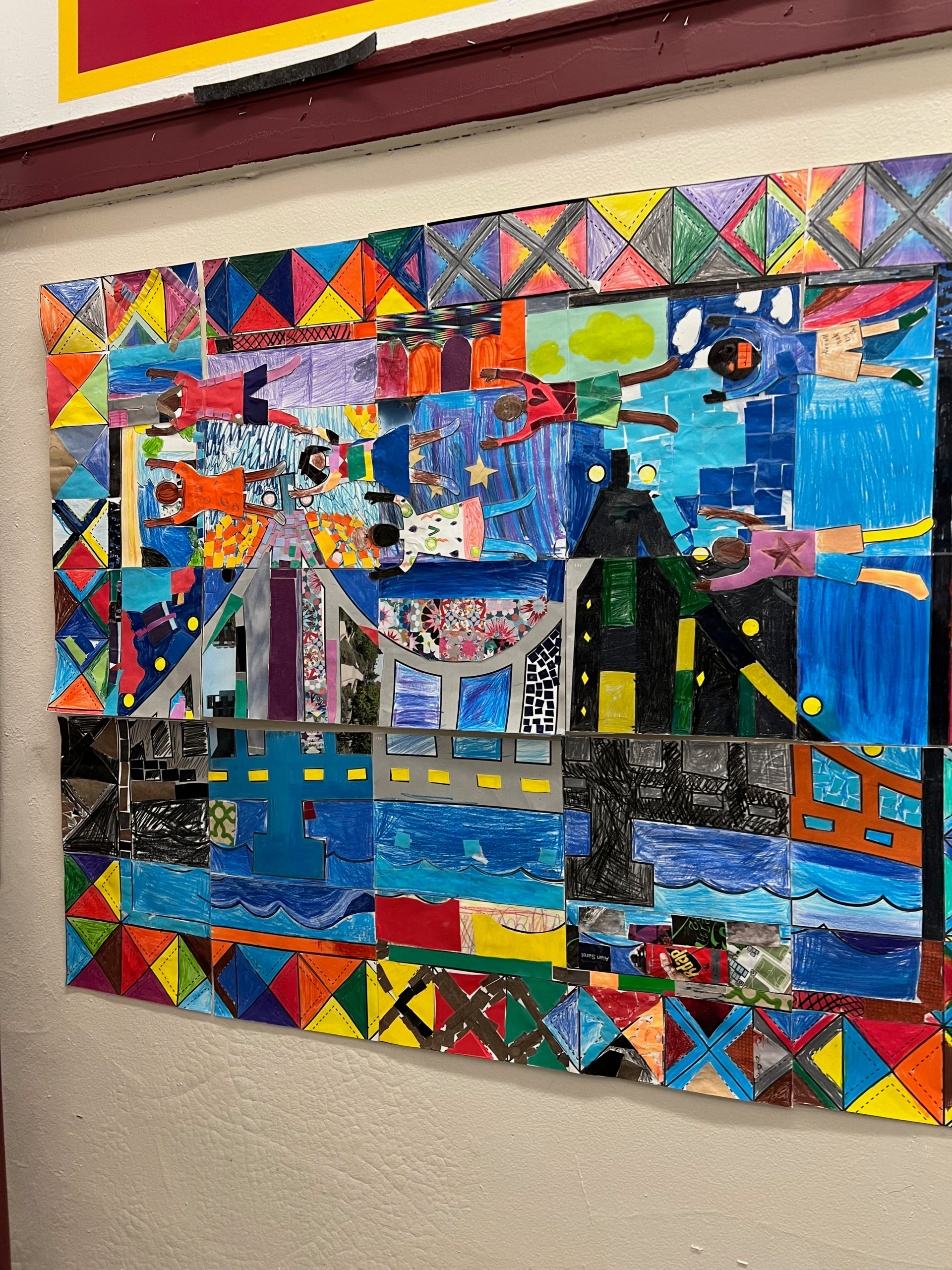
Unit design, session scripts and teaching routines: Kacy George, Grade 8 Unit “Places We Call Home: Collage & The Block,” 2026–27. Artist reference: Romare Bearden, The Block, 1971, The Metropolitan Museum of Art. Classroom photograph: KC George’s classroom archive; it shows related collaborative work, not this unit.