Gestures, Marks and Music
Free to teach, adapt and share in your classroom.
- Grade 6–8
- Subject Visual Arts
- Duration 4 sessions · 45 min
- Instructor Mr. George
Overview
Unit Context: Expressive mark-making in charcoal and graphite · pressure, opposites, words and sound translated into line · a reassembled composition built from the strongest marks
Big Idea
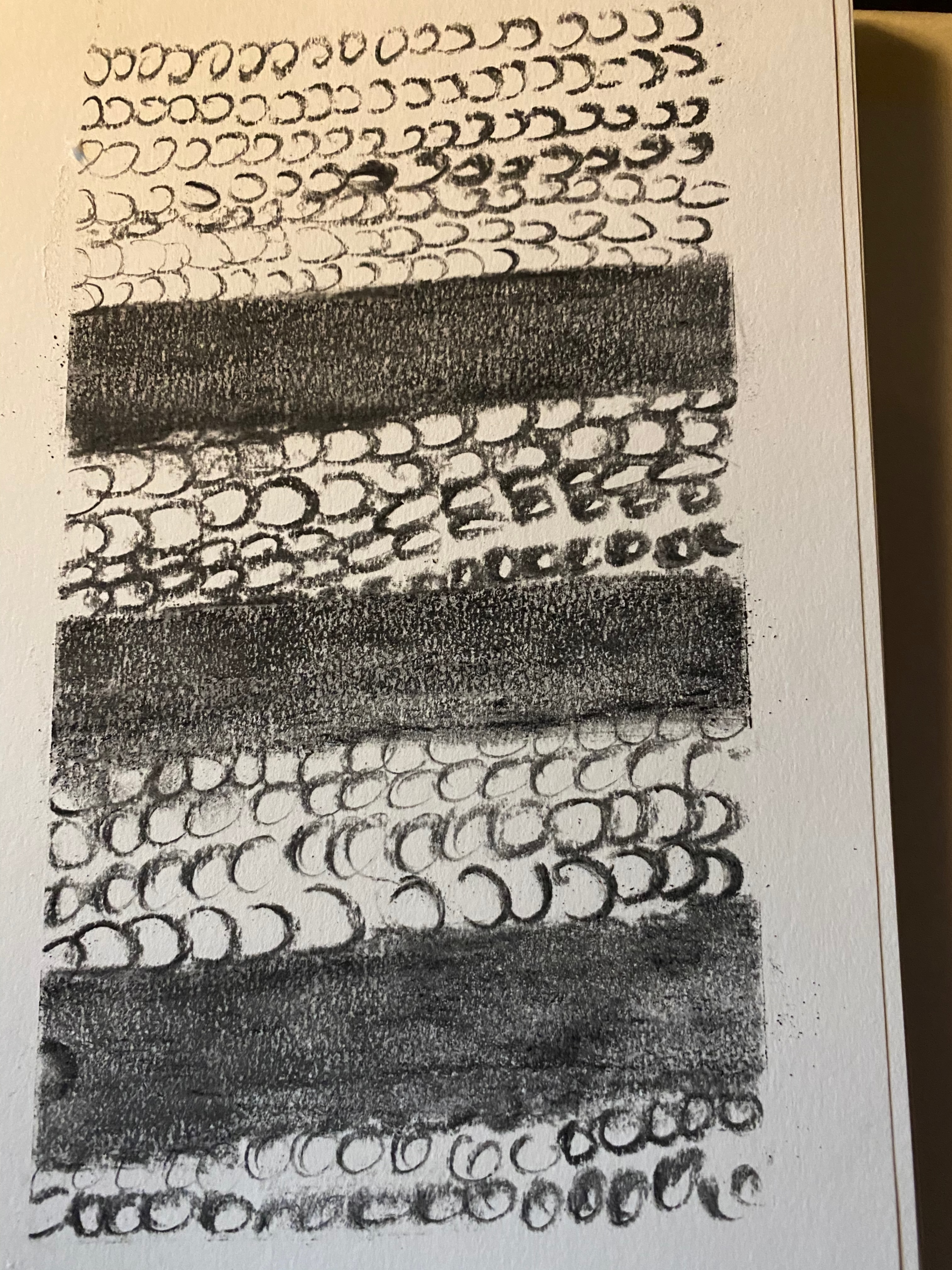
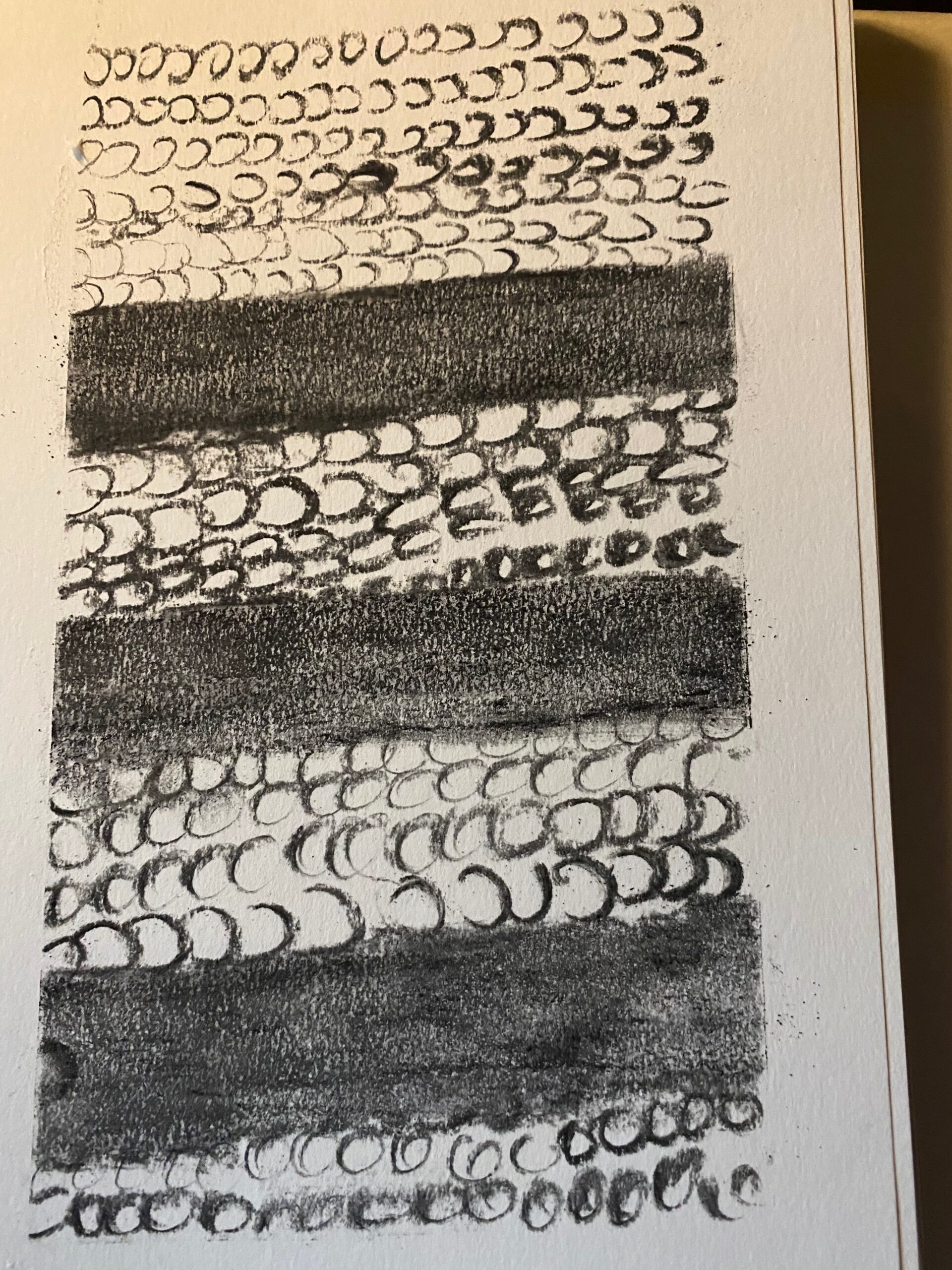
A mark is a record of a gesture, and gestures carry feeling. Students push pressure to extremes, translate words and music into marks, then cut and reassemble their strongest passages into a composition that a viewer can read as loud, quiet, tense or calm.
The central question is: How can a mark carry a feeling or a sound?
Planning status: This lesson is rebuilt from KC George’s 2021 gesture and mark-making explorations: opposite adjectives, words at play, and drawing to music. The original had no pacing and needed changes for classroom use. There is no blindfold, and looking at your paper is never called cheating. Music is a set of short, teacher-selected instrumental clips rather than a commercial playlist. Charcoal dust and fixative routines are added. The four-session pacing is a proposed adaptation, not a report of a taught unit. Blind contour drawing is taught separately in The Politics of Perception.
Unit at a Glance
| # | Session and goal | Time |
|---|---|---|
| 1 | The mark chart and the artistsMake and name twelve kinds of marks and find gestures in artists’ work. | 45 min |
| 2 | Opposites and words at playUse pressure and speed to make marks that feel opposite, then interpret words with marks. | 45 min |
| 3 | Drawing to soundRespond to music with marks and choose passages worth keeping. | 45 min |
| 4 | Cut, reassemble, titleBuild a new composition from my strongest marks and explain the feeling it carries. | 45 min |
| 4 sessions | 180 min |
Artists for Looking
Choose two or three for a short looking routine in Session 1: Wassily Kandinsky, Cossacks, 1910–11; Joan Mitchell, Plate (folio 16) from The Poems, 1960; Lee Krasner, Charred Landscape, 1960; Uche Okeke, Savannah Landscape, 1962; Judith Godwin, Epic, 1959. Ask students to point to one mark and name the gesture that made it, whether fast, slow, pressed or light, before talking about what it means. Project from museum collection pages.
NYS Visual Arts Standards Alignment
Suggested alignment for grades 6–8. Confirm the exact indicator wording for your grade.
- VA:Cr2.1.6a–8a Creating: experimenting with media and approaches. Pressure extremes and timed mark responses.
- VA:Cr3.1.6a–8a Creating: reflecting and revising. Selecting and reassembling the strongest passages.
- VA:Re7.2.6a–8a Responding: how visual features communicate. Reading loud, quiet, tense or calm in marks.
- VA:Re8.1.6a–8a Responding: interpreting artwork. Looking at Kandinsky, Mitchell, Krasner and Okeke.
Instructional Outcomes (Objectives)
- Studio / Experiential Students will produce at least twelve named mark types in charcoal and graphite and control pressure from very light to very heavy.
- Cognitive / Analytical Students will explain how pressure, speed, direction and repetition make a mark read as a particular feeling or sound.
Key Vocabulary
The twelve-term mark chart. Each term is posted beside a mark a student made.
- Stippling Dots built up to make value.
- Hatching Parallel lines.
- Cross-hatching Layers of crossing parallel lines.
- Contour A line that follows an edge.
- Zigzag A sharp back-and-forth line.
- Dots and dashes Broken, rhythmic marks.
- Spirals Lines that wind around a center.
- Wavy A smooth, rolling line.
- Scratchy Short, rough, broken strokes.
- Vertical Upright strokes.
- Scribbling Fast, tangled, continuous marks.
- Loose Relaxed marks made from the shoulder, not the fingers.
- Gesture / pressure The movement that makes a mark, and how hard the tool presses.
Materials & Resources
- Drawing tools: vine and compressed charcoal, graphite sticks and pencils (2B–8B), kneaded erasers, and one or two other tools per table (chalk pastel, a brush with ink, or a twig).
- Paper: 9 × 12 drawing paper for studies and large sheets (18 × 24 or a roll) taped to tables or the wall for the music session.
- Viewfinders: two L-shaped pieces of card per student.
- Collage: scissors and glue sticks for the reassembled composition.
- Music: five to eight short instrumental clips chosen and previewed by the teacher, varied in tempo and mood. No lyrics.
- Mark chart: the twelve terms typed and posted, each with a space for a student-made sample.
- Cleanup: damp cloths or wipes, a lined bin for tapping dust, and handwashing at the end of each charcoal session.
Charcoal safety: tap excess dust into the lined bin and never blow it off the paper. Wipe tables with a damp cloth rather than brushing dust into the air, and wash hands before leaving. If work is fixed, the teacher applies fixative alone, outdoors or in a well-ventilated space, never with students present. Many classrooms simply interleave finished drawings with newsprint instead.
Differentiation
- Fine-motor supports Thicker charcoal or graphite sticks, tool holders, paper taped down, and working at an easel or wall so marks come from the whole arm.
- Multilingual learners Opposite adjectives are given as word pairs with icons (loud and quiet, hard and soft, fast and slow). Words for Words at Play can come from a home language.
- Social-emotional Students who prefer not to draw in front of others can work on a smaller sheet at their seat during the music session. Feelings stay general: no student is asked to draw a personal experience.
- Extension Translate the strongest passage into a second medium such as ink wash, or into a small painting.
Anticipated Misconceptions
Misconception Expressive drawing means messy scribbling with no control.
Intervention Name the mark, then remake it on purpose. Every mark on the chart can be made loudly or quietly, slowly or quickly.
Misconception Smudging everything makes it look finished.
Intervention Gray mush hides the gesture. Keep one area untouched and compare it with a blended area.
Instructional Sequence
Four proposed 45-minute sessions: entry (0–5), demo or looking (5–12), studio (12–33), share (33–38) and a charcoal reset (38–45).
Session 1The mark chart and the artists
45 min
Today, I can… make and name twelve kinds of marks and find gestures in artists’ work.
Materials today: Charcoal and graphite, 9 × 12 paper folded into twelve boxes, the mark chart, two or three artworks projected.
Do Now: one line, three ways
“Draw one line three times: as slow as you can, as fast as you can, and as hard as you dare.”
Looking: what made that mark?
Project two artworks. Students point to one mark and name the gesture that made it before discussing meaning.
“Was this fast or slow? Pressed or light? How can you tell?”
Studio: the twelve-box chart
Students fill twelve boxes with the twelve chart marks, labeling each. Then they redo three of them at the opposite pressure.
“Name the mark, then remake it deliberately.”
Check: All twelve boxes are filled and labeled.
Share: pin the best example
Each table pins one strong example of each mark to the chart.
“Which mark changed most when you changed the pressure?”
Charcoal reset
Tap dust into the lined bin, interleave drawings with newsprint, wipe tables with damp cloths, return tools by count, and wash hands.
“Dust goes in the bin, never into the air.”
Session 2Opposites and words at play
45 min
Today, I can… use pressure and speed to make marks that feel opposite, then interpret words with marks.
Materials today: Graphite and charcoal, two 9 × 12 sheets per student, opposite-adjective cards and word cards.
Do Now: loud and quiet
“Make one loud mark and one quiet mark. What did your hand do differently?”
Demo: hard and soft drawings
Model a hard drawing with heavy, scratchy, fast marks, then a soft one holding the tool far from the tip so it barely touches.
“Push yourself to the extremes. Then enjoy the difference between the two.”
Studio: opposites, then words
Ten minutes: a hard drawing and a soft drawing. Then eleven minutes: draw five chosen words, one to two minutes each, letting the marks overlap.
“Interpret the word with marks, not pictures.”
Check: Students can say which marks belong to which word.
Share: guess the word
Partners guess one of the five words from the marks alone.
“What in the marks gave it away?”
Charcoal reset
Tap dust into the lined bin, interleave drawings with newsprint, wipe tables with damp cloths, return tools by count, and wash hands.
“Dust goes in the bin, never into the air.”
Absent last time? Fill six boxes of the mark chart first; the posted class examples show every mark.
Session 3Drawing to sound
45 min
Today, I can… respond to music with marks and choose passages worth keeping.
Materials today: Large paper taped to tables or the wall, four or five tools within reach, the teacher clip set, viewfinders.
Do Now: listen first
Play ten seconds of one clip with no drawing.
“If this sound were a line, what would it look like? Sketch it small.”
Demo: one clip, live
Draw to a short clip in front of the class, switching tools when the music changes. Introduce Kandinsky’s idea that color and line can work like music.
“Your marks can overlap. You are drawing the sound, not a picture of it.”
Studio: the clip sequence, then the viewfinder
Play five to eight clips back to back, about 30 seconds each with a short pause between. Then students float a viewfinder over the sheet to find three passages they want to keep.
“Use your whole arm. Switch tools when the music changes.”
“Find three areas where the marks feel most alive.”
Check: Three passages are marked on each sheet.
Share: which clip is this?
Volunteers show one passage, and the class guesses which clip it came from.
“What in the marks matches the sound?”
Charcoal reset
Tap dust into the lined bin, interleave drawings with newsprint, wipe tables with damp cloths, return tools by count, and wash hands.
“Dust goes in the bin, never into the air.”
Absent last time? Fill six boxes of the mark chart first; the posted class examples show every mark.
Session 4Cut, reassemble, title
45 min
Today, I can… build a new composition from my strongest marks and explain the feeling it carries.
Materials today: Session 1–3 drawings, scissors, glue sticks, backing paper, drawing tools for linking marks, title cards.
Do Now: choose the feeling
“Look at your three passages. Write one word for the feeling you want your final piece to carry.”
Demo: rearrange before gluing
Cut passages from a teacher sheet, test new distances, rotate pieces, then draw new marks to connect them.
“Try three arrangements before you glue anything.”
Studio: compose
Students cut their passages, test arrangements, glue the chosen one, and draw connecting marks that strengthen the feeling.
“Does the new composition carry your word? What would make it stronger?”
Check: A glued composition with connecting marks.
Share: title and evidence
Students write a title and name one mark that carries the feeling.
“Point to the mark that does the most work.”
Charcoal reset
Tap dust into the lined bin, interleave drawings with newsprint, wipe tables with damp cloths, return tools by count, and wash hands.
“Dust goes in the bin, never into the air.”
Exit Ticket Prompt
Name the feeling your composition carries, and point to one mark (by its chart name) that makes it work.
Assessment & Reflection
- Range of marks All twelve chart marks made and named, with control of pressure from light to heavy.
- Expressive choice Marks chosen to match a word, a sound or a feeling, with an explanation.
- Composition The reassembled piece reads as one feeling, with connecting marks.
- Studio habits (separate) The dust routine, tool counts and handwashing are coached, not graded as art.
Related Lessons
The Politics of Perception pairs well before this lesson.
Sources & Credits
Explorations: Kacy George, materials-and-methods gesture and mark-making explorations, 2021. Rebuilt for classroom use in 2026, with proposed pacing, a safety routine and the twelve-term mark chart typed from the original. Teacher exploration photograph: KC George coursework archive.